Pay in 3 or 4 interest-free installments
Pay in 3 or 4 interest-free installments
Pay in 3 or 4 interest-free installments
Pay in 3 or 4 interest-free installments
Pay in 3 or 4 interest-free installments
Pay in 3 or 4 interest-free installments
Pay in 3 or 4 interest-free installments
Pay in 3 or 4 interest-free installments
Pay in 3 or 4 interest-free installments
Pay in 3 or 4 interest-free installments
Pay in 3 or 4 interest-free installments
Pay in 3 or 4 interest-free installments
At SAILIZ, we’ve chosen to produce as locally as possible to guarantee high-quality technical gear while managing its impact and manufacturing conditions. Our collections are designed in France and made in nearby Europe with carefully selected partners. In this article, we’ll take you to discover where SAILIZ gear is made and why these production choices are an integral part of our commitments.
Manufacturing in nearby Europe
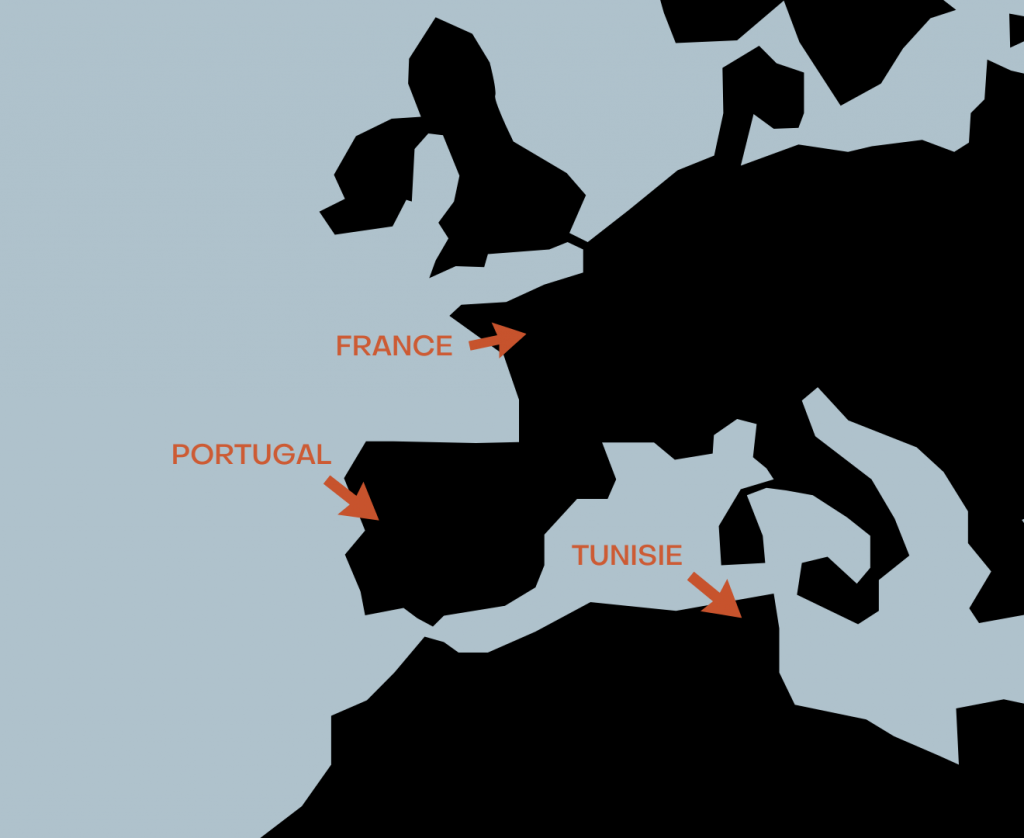
The main challenge for producing SAILIZ gear is finding the right balance between market reality and production that respects our values. That’s why we are supported in production by manufacturers in France, Portugal, and Tunisia.
Production in France
Producing in France is a real challenge for SAILIZ. While this choice aligns with our values of proximity, quality, and transparency, it remains complex to implement for demanding technical clothing. Between manufacturing costs, the availability of specific expertise, and access to technical materials, French production requires overcoming many hurdles. However, we continue to explore these possibilities, convinced that producing in France is an important lever for better managing our production and strengthening our commitments.
We have still been able to find a few French players to support us in the production of our SAILIZ gear.
Our technical base layers, tops and bottoms, as well as our neck warmers, are produced in France by Henitex, a partner specializing in technical textile manufacturing. This choice allows us to promote local expertise while ensuring a high level of quality and precision in manufacturing. Producing these essential performance base layers in France also offers us better proximity to our workshop, facilitating production monitoring and technical adjustments. It’s an important step in our process of gradually reshoring certain key items from our collections.
Our beanies are made in France by Manufacture de Layette (MLT), a workshop recognized for the quality of its textile expertise. Working with MLT allows us to benefit from precise expertise and careful manufacturing.
For our socks, we chose to work with another specialist: Manufacture Broussaud is a French family business that has specialized in sock manufacturing for several generations. Based in France, it carries on recognized textile expertise, combining tradition and innovation to produce high-quality technical items. At SAILIZ, working with Manufacture Broussaud allows us to offer products designed and made in France, with particular attention paid to durability, comfort, and manufacturing precision.
Production in Portugal
Northern Portugal hosts a significant portion of European textile production. Having our clothes produced in Portugal is a choice that balances technicality, quality, and proximity. Portugal has recognized textile expertise, particularly for technical clothing, with workshops capable of meeting high standards for cutting, assembly, and finishing. This expertise allows us to develop high-performance, durable products suitable for sailing. This is why SAILIZ gear like the offshore bibs and jacket, as well as a large part of our lifestyle clothing, are made in the Porto region.
Producing in Portugal also allows us to stay within nearby Europe, which facilitates production monitoring, communication with workshops, and quality control. This proximity helps us work more effectively with our partners and adjust our products throughout their development.
Finally, this choice is part of our responsible approach: European social and environmental standards provide a demanding framework, and production conditions are better managed. Producing in Portugal thus represents a consistent compromise between commitment, quality, and feasibility for technical clothing.
Production in Tunisia
Tunisia has solid textile expertise, particularly in manufacturing technical clothing and structured series. The workshops are experienced, responsive, and capable of working with precision on demanding products. Geographical proximity to Europe also allows for reasonable transport times and relatively smooth exchanges with manufacturers. Finally, more accessible production costs help maintain balanced prices while maintaining a good level of quality. However, the distance remains greater than for production in Europe, making production monitoring and factory visits less simple to organize.
For SAILIZ, production in Tunisia was an important step in the brand’s development, especially for offshore products. Today, we are gradually looking to move some manufacturing closer to Europe whenever possible, in order to improve proximity, monitoring, and production control. Only our NEO overalls are still produced in Tunisia; all other SAILIZ gear is now produced in Europe.
Ecological impacts
Transport has a real impact on the ecological footprint of gear, but it actually represents a relatively limited part of the textile life cycle. It is estimated that transport accounts for about 3% of the total emissions in the fashion value chain, while the majority of the impact comes from material production and manufacturing.
In practice, reducing transport distances is useful, but the most important levers often remain:
choice of materials
product durability
recycling
At SAILIZ, the choice of materials is an essential lever for reducing the environmental impact of our technical clothing. We prioritize durable materials suitable for intensive use at sea, in order to design products that last over time and avoid too frequent replacement. A garment’s durability remains one of the most important factors in limiting its ecological footprint.
Our technical clothing is mainly made of polyester (PES), a material particularly suited to the constraints of sailing for its strength, stability, and performance. We have chosen 100% polyester and therefore 100% recyclable materials, which allows for better management of the gear’s end-of-life and fits into a circular economy logic. ♻️
Beyond technical performance, we seek to select reliable and traceable materials produced according to demanding standards. Improving environmental impact involves both the choice of materials and the quality of the gear: designing solid, repairable, and recyclable technical gear is at the heart of the SAILIZ approach.
Pour offrir les meilleures expériences, nous utilisons des technologies telles que les cookies pour stocker et/ou accéder aux informations des appareils. Le fait de consentir à ces technologies nous permettra de traiter des données telles que le comportement de navigation ou les ID uniques sur ce site. Le fait de ne pas consentir ou de retirer son consentement peut avoir un effet négatif sur certaines caractéristiques et fonctions.
Fonctionnel
Always active
Le stockage ou l’accès technique est strictement nécessaire dans la finalité d’intérêt légitime de permettre l’utilisation d’un service spécifique explicitement demandé par l’abonné ou l’internaute, ou dans le seul but d’effectuer la transmission d’une communication sur un réseau de communications électroniques.
Préférences
Le stockage ou l’accès technique est nécessaire dans la finalité d’intérêt légitime de stocker des préférences qui ne sont pas demandées par l’abonné ou la personne utilisant le service.
Statistiques
Le stockage ou l’accès technique qui est utilisé exclusivement à des fins statistiques.Le stockage ou l’accès technique qui est utilisé exclusivement dans des finalités statistiques anonymes. En l’absence d’une assignation à comparaître, d’une conformité volontaire de la part de votre fournisseur d’accès à internet ou d’enregistrements supplémentaires provenant d’une tierce partie, les informations stockées ou extraites à cette seule fin ne peuvent généralement pas être utilisées pour vous identifier.
Marketing
Le stockage ou l’accès technique est nécessaire pour créer des profils d’internautes afin d’envoyer des publicités, ou pour suivre l’internaute sur un site web ou sur plusieurs sites web ayant des finalités marketing similaires.

 English